Press kit
Inkbreaker press & media kit
Now live · May 2026Everything you need to write about, cover, or link to Inkbreaker. For anything not covered here, email press@inkbreaker.com.
At a glance
- Name
- Inkbreaker
- Developer
- Spiffai LLC
- Headquarters
- Savannah, GA
- Founded (Spiffai LLC)
- 2016
- Inkbreaker launched
- 2026
- Website
- inkbreaker.com
- Platform
- Web, plus native apps: desktop for Windows, macOS, and Linux, and mobile for iOS and Android. The apps work offline. No install required to start on the web.
- Editor
- Full writing environment, free, including the desk. Tested against a 200,000 word manuscript held in one piece, where a keystroke costs about 2 milliseconds with no dropped frames. Import and ordinary export are free. Advanced writing modes and Imprint book formatting are Pro.
- Community
- Feed, publishing, follows, comments, peer feedback queue, games, and community management tools.
- Engine type
- 100% deterministic. No language models. No generative AI in scoring.
- Free tier
- Three exercises a day and up to 100 pieces, private and shared counted together. Full prose metrics, XP, skill progression, leaderboards, community, and every peer feedback lane. Read-aloud and voice dictation are free accessibility features on every plan. Work syncs across web, desktop, and phone at no cost. No time limit.
- Pro tier
- $12 a month or $120 a year ($10 a month billed annually). Prices vary by platform, because App Store and Google Play pricing absorbs the store fee. Unlimited daily exercises, the worldbuilding suite, Imprint book formatting, and cloud backup to the writer’s own Google Drive or OneDrive.
- Daily exercise limit
- Three a day on Free (resets at midnight in your time zone). Unlimited on Pro.
- Free trial
- 7 days of Pro, which every new account can start. No credit card required.
- Writing types
- Fiction, nonfiction, poetry, screenwriting, journalism, blogging, technical writing, copywriting, and worldbuilding.
- Languages
- Ten, for the interface and for the analysis engines: English, German, Spanish, French, Italian, Portuguese, Russian, Japanese, Korean, and Chinese. A piece is read on its own language's terms rather than by English rules translated across: that language's readability formula, its verb paradigms for tense, and its dialogue punctuation, including guillemets and the opening dash. No figure is an English measure applied to another language. The exercises and the support documentation are translated too. Engine language support is in beta.
- Metrics engine
- Flesch-Kincaid (1975), Gunning Fog (1952), Coleman-Liau (1975), and Brysbaert (2019).
- Writing tools (Pro)
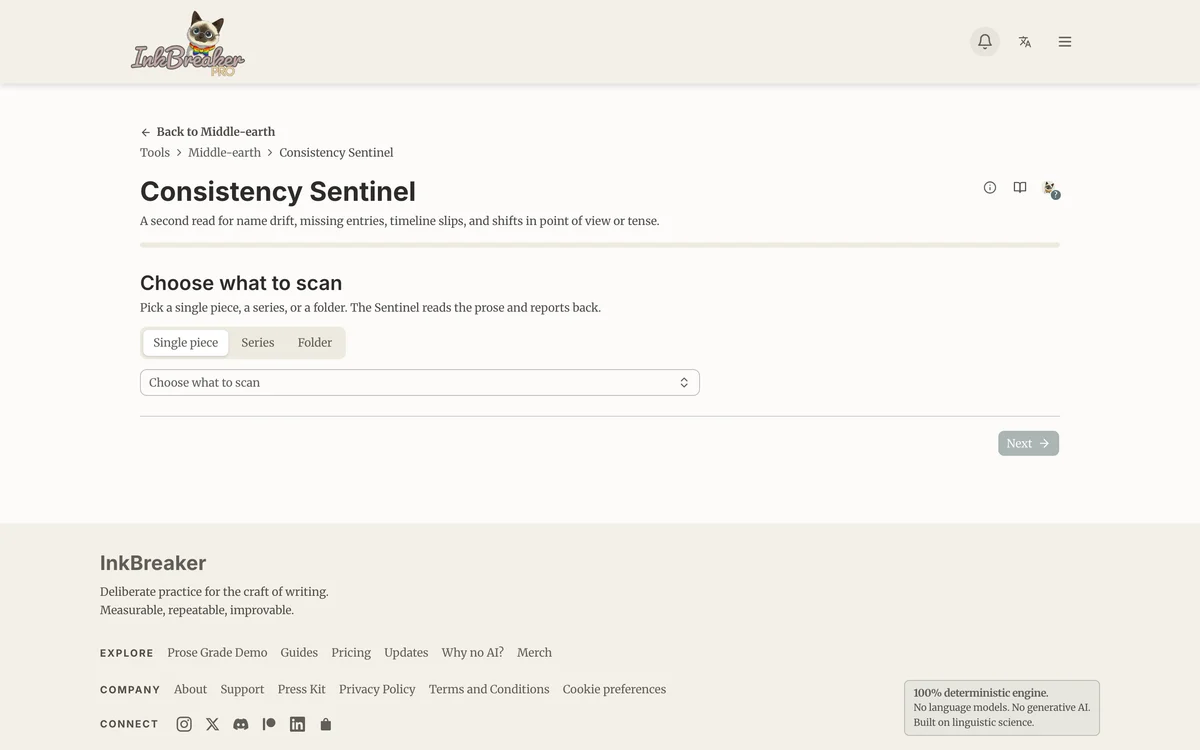
- Four worldbuilding tools (Lexicon Engine, Time Weaver, Relationship Web, World Bible), the Sentinel that catches continuity slips across any writing type, and genre tool suites for screenwriting, poetry, fiction, journalism, and copywriting. All deterministic, no AI.
- Data policy
- Processed on our own servers. Never sent to a third-party AI, never used for training. Your work is saved to your account so you can come back to it, and deleting it deletes it. The free demo saves nothing.
- AI usage
- None. No AI integrations of any kind. Content moderation is a deterministic, rule-based filter plus human review.
- Content policy
- All exercises and feedback are written by people. Inkbreaker has no AI writing tools, so the work here stays your own.
- Mission
- Give writers a full platform for the craft, with deliberate practice and measurable feedback built in.
- Press contact
- press@inkbreaker.com
What people are saying about Inkbreaker
I've mostly used this for the writing exercises, which are great for keeping up the habit when I don't have a big project. But the full writing tools are kind of ridiculous (in the best way!): deep worldbuilding, 200k+ word manuscripts, Meridian analysis, sprint rooms, accountability groups, critique swaps, etc. I LOVE that there's no generative AI. Just engines, math, and take-or-leave-it feedback that help you do your own writing. Makes me want to start a novel just to use more of it! :)
This app is great for any and every type of writer. There are extensive exercises for new and experienced writers to hone their craft, tools to build an entire world to write around, and community to give and receive feedback. It even allows for easy and ialmost seamless mportation of your files. They also include proof of authorship and let you connect a Google drive or OneDrive. An absolute must for the writer at home or on the go.
Big fan of the exercises and tools that are available through the app! A great way to keep my worldbuilding organized!
Story angles
Editorial framings, free for press use. Not attributed quotes.
Built without AI, on purpose
Most edtech is wrapping large language models in coaching personas. Inkbreaker went the other way. Every score comes from a deterministic formula with decades of research behind it, and anyone can check it by hand. No model touches the scoring.
The writing tool that stopped being one tool
A working novelist today pays for a word processor, a story bible, a feedback community, and a practice habit separately, then keeps them in sync by hand. Inkbreaker combines seven things most writing software treats as separate products: an editor that holds a 200,000 word manuscript at about 2 milliseconds a keystroke, free sync across web, desktop, and phone, a worldbuilding suite with maps and constructed languages, sixty-plus deliberate-practice exercises, a deterministic scoring engine, a peer feedback community, and authorship protection with DMCA takedown support. The claim is specific and checkable: no other writing platform offers all seven. The founder built it that way because the seams between tools are where drafts go to die.
A scoreboard for writers
Software engineers have had scored coding practice for years. Writers haven't had anything like it. Inkbreaker scores prose against published formulas, tracks each submission against benchmarks for its genre, and shows the writer whether a skill is improving.
She built AI writing feedback first
In her last role, the founder built AI feedback for student writing and tried every approach she could find to make it help writers improve. A draft a model polished was a draft the writer didn't learn from. Inkbreaker is what she built instead.
Nine benchmarks, one engine
A poet, a screenwriter, and a journalist cannot share a writing tool. Their craft demands are too different. Inkbreaker calibrates nine separate benchmark sets, one per writing type, each built from published research for that genre. The same passage scored as fiction and as technical writing produces different ratings. Most writing tools treat prose as one thing.
Ten languages, ten sciences
Writing software that claims to support other languages usually means the buttons are translated. The analysis underneath stays English. Flesch was fitted on English readers reading English, so a German paragraph scored by it produces a number that means nothing, and an adverb check built on the suffix "-ly" finds nothing at all in Japanese. Inkbreaker measures each of its ten languages by the research that language produced for itself: Amstad for German, Fernandez Huerta for Spanish, Gulpease for Italian, which counts letters rather than syllables, Oborneva for Russian, and a Korean formula that reports a school grade rather than an ease score. Tense is read from each language's verb paradigms, and speech opened with guillemets or a dash is read as speech. The principle underneath: every figure a writer sees comes from a measure built for that language, never from an English score carried across.
The platform that documents your drafting instead of guessing at your prose
Writers are increasingly being told by a detector, a platform, or a reader that work they wrote themselves looks machine made. It is a hard accusation to answer, because it asks a writer to prove a negative about finished prose. Inkbreaker takes the opposite approach to the whole category: rather than running another statistical guess over the words, it keeps a dated provenance record of the work being made. First draft, every revision since, time spent, whether text was pasted in and what became of it, and a content fingerprint anchored to the Bitcoin blockchain, for drafts as well as published work, so its age can be checked without trusting the company. There is a specific and underreported angle here: independent peer-reviewed testing has found detectors misfire disproportionately on genre and creative fiction, because trope-driven vocabulary, ritualized dialogue rhythm, and careful editing all flatten exactly the statistical variation detectors treat as the signature of a human.
A daily writing loop
Most writing tools sit beside your work and suggest changes. Inkbreaker is where the work lives: draft, run a targeted exercise, check your metrics, and ask someone who knows the form for a read. Then do it again tomorrow.
For the full technical and philosophical background, see below, or read it at inkbreaker.com/why.
Journalist FAQ
Most writing tools correct a finished draft. Inkbreaker measures specific craft skills across repeated exercises, so writers can see whether a skill is improving.
No. The prose analysis engine runs fixed mathematical formulas, not machine learning models. Text is processed server-side on our own infrastructure, never sent to third-party AI providers, and never used for training. The engine keeps no separate copy of your text. When you are signed in, your work is saved to your account, on your desk and in your submission history, because it is yours to come back to, and deleting it deletes it. Text pasted into the free public demo is not saved to an account. Inkbreaker has no AI integrations at all. Content moderation is a deterministic, rule-based filter plus human review.
Fiction, nonfiction, poetry, screenwriting, journalism, blogging, technical writing, copywriting, and worldbuilding. Each has its own exercise library and its own benchmark set. The targets for a screenwriter are different from those for a journalist because the craft demands are different.
The full platform is free with no time limit. The editor, exercises, metrics, XP, skill progression, leaderboards, community, peer feedback, read-aloud and voice dictation, and importing and exporting drafts are all included at no cost, and work syncs across web, desktop, and phone for free. Pro adds the worldbuilding suite, metric history and trend analysis across all submissions, advanced writing modes, Imprint book formatting, and cloud backup to a writer’s own Google Drive or OneDrive. Pro is $12 a month or $120 a year. Prices vary by platform, because App Store and Google Play pricing absorbs the store fee. Every new account can start a 7-day Pro trial. No credit card required.
One-liner
A complete writing studio. A full editor that holds a novel, a deep worldbuilding suite, deliberate practice scored by a deterministic engine, a community of careful readers, book formatting to print-ready PDF and EPUB, and authorship protection with DMCA takedown support. Most writing tools give a writer one piece of that. No AI anywhere. Live now, on web, desktop, and mobile.
Short boilerplate
Inkbreaker is a writing platform that makes the craft measurable. Writers draft in a full editor, complete targeted exercises, get objective metrics on their prose, and receive honest feedback from other working writers. No audience to perform for, no vague advice, and no shortcuts.
Long boilerplate
Inkbreaker is a writing platform for writers who want to improve, built by Spiffai LLC. It pairs a distraction-free editor and a manuscript binder with a worldbuilding suite, a book formatter that exports print-ready PDF and EPUB, a cover design studio, interactive maps and constructed-language tools, deterministic prose analysis, and a publishing community, giving writers the same feedback loop that athletes and musicians use to improve. Read-aloud and voice dictation are free and accessible, and the desktop and mobile apps work offline. The platform measures readability, sentence variety, vocabulary density, passive voice, dialogue ratio, sentiment, coherence, grammar patterns, originality, and more, and tracks those numbers across every draft.
Every piece of creative writing on Inkbreaker is written by a human. Prose analysis on the platform is fully deterministic; each metric is computed by a transparent algorithm, not a language model. There is no AI anywhere on the platform; content moderation runs on a deterministic, rule-based filter plus human review, not a language model. Inkbreaker does not generate prose and does not offer AI feedback; the writing and the critique here come from people. Inkbreaker supports fiction, nonfiction, poetry, screenwriting, journalism, technical writing, copywriting, blogging, and worldbuilding.
Founder

Alyssa Glasco
Founder, Spiffai LLC.
Alyssa Glasco founded Spiffai LLC and builds Inkbreaker. She writes narrative for indie games, including S2V2, Starwish Astrinomica and Palindrome, and has worked as a software engineer for more than 15 years.
She started Inkbreaker to work on her own writing and couldn't find a tool that measured prose craft. So she built one, with no AI in it. Every score comes from published readability research and can be checked by hand.
Media requests and interview inquiries can be sent to press@inkbreaker.com.
Press kit.
For coverage inquiries: press@inkbreaker.com
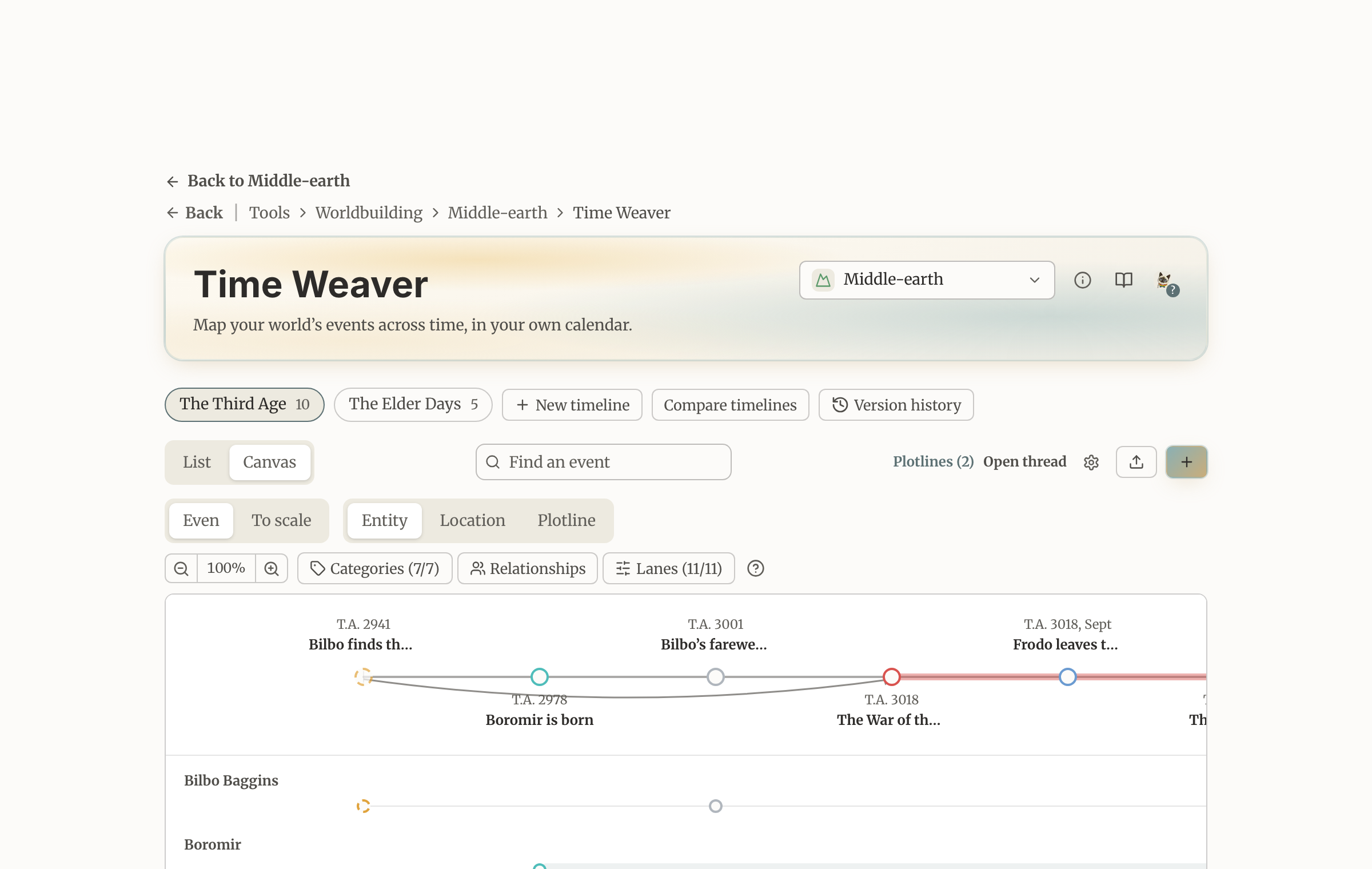
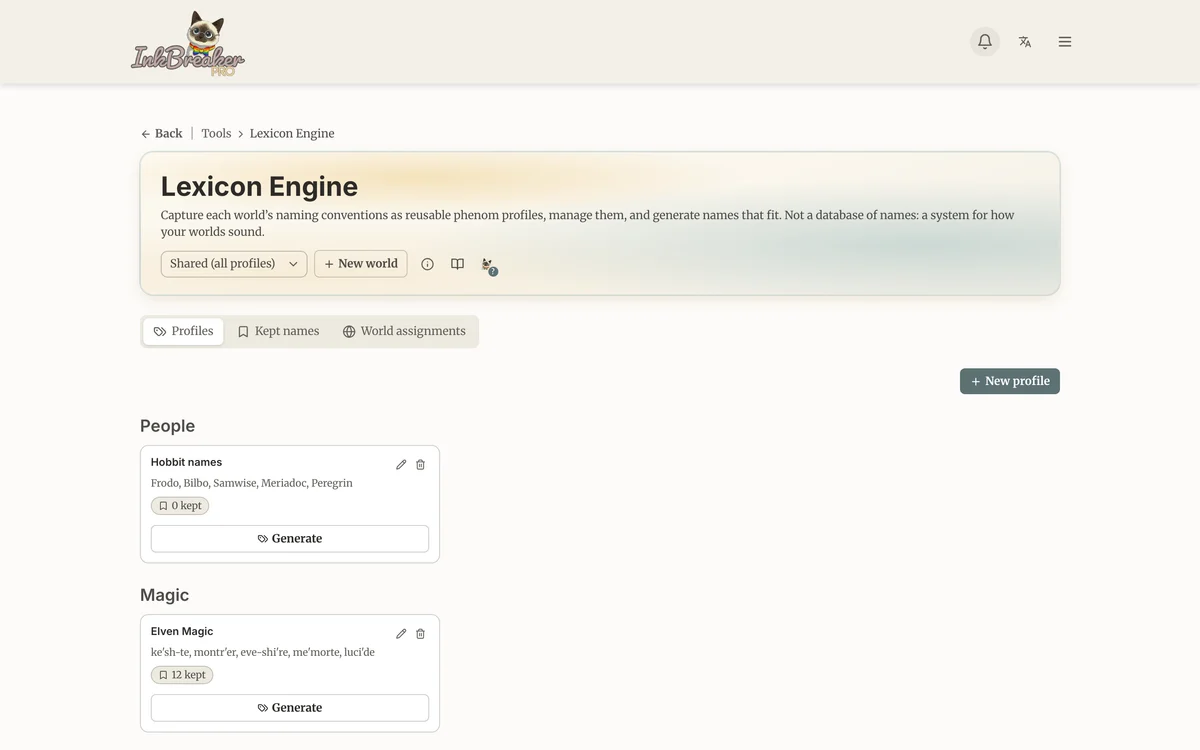
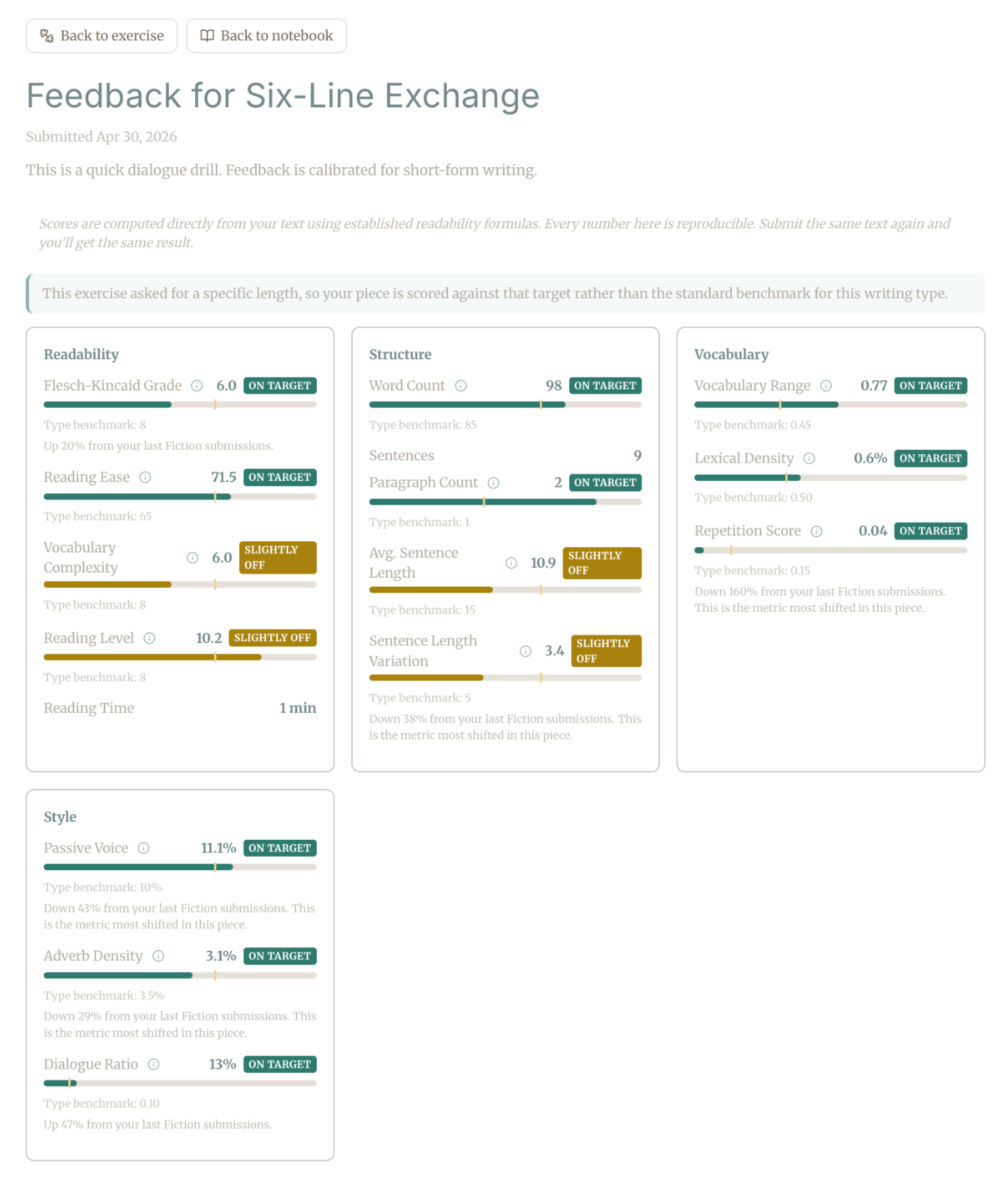
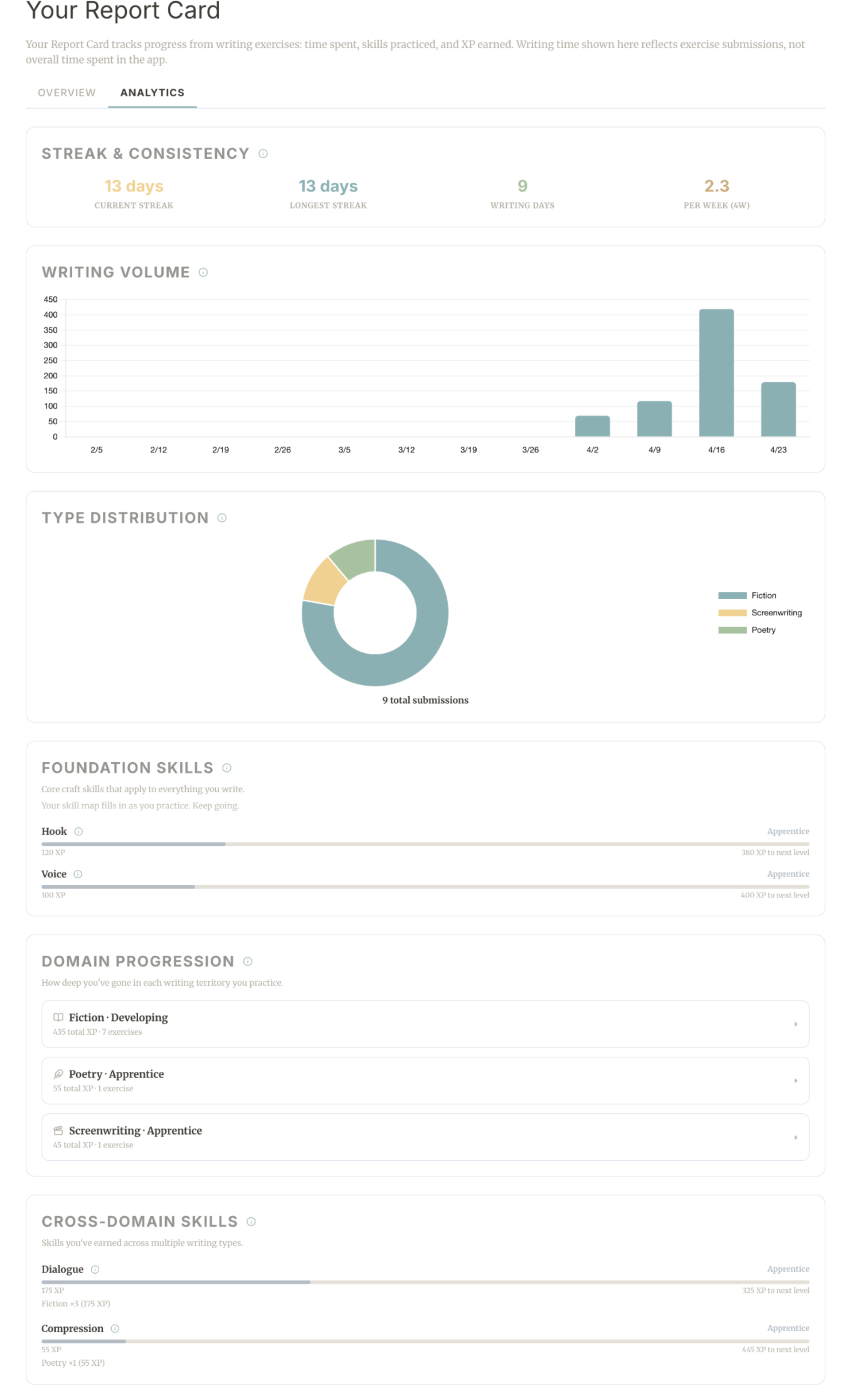
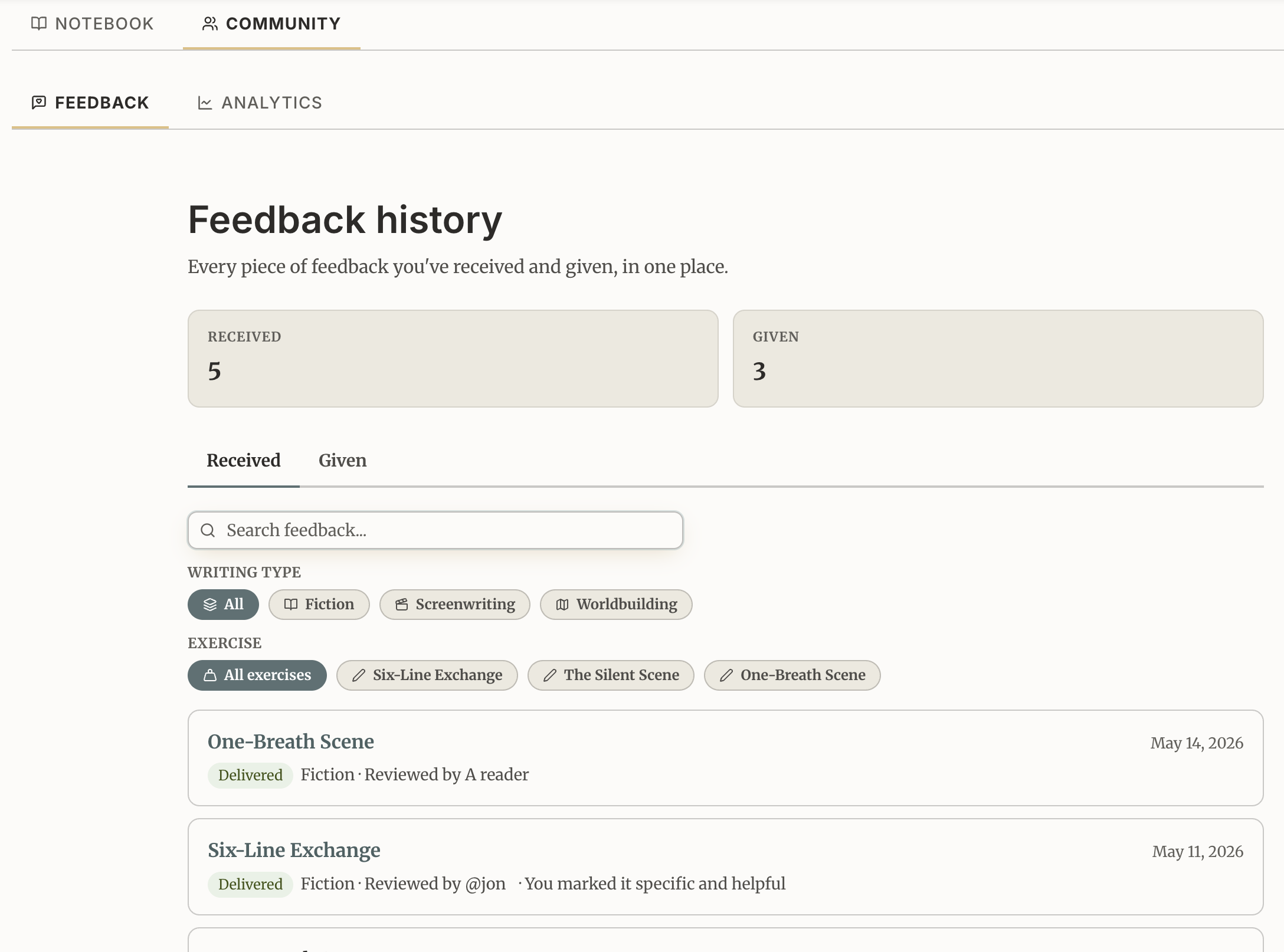
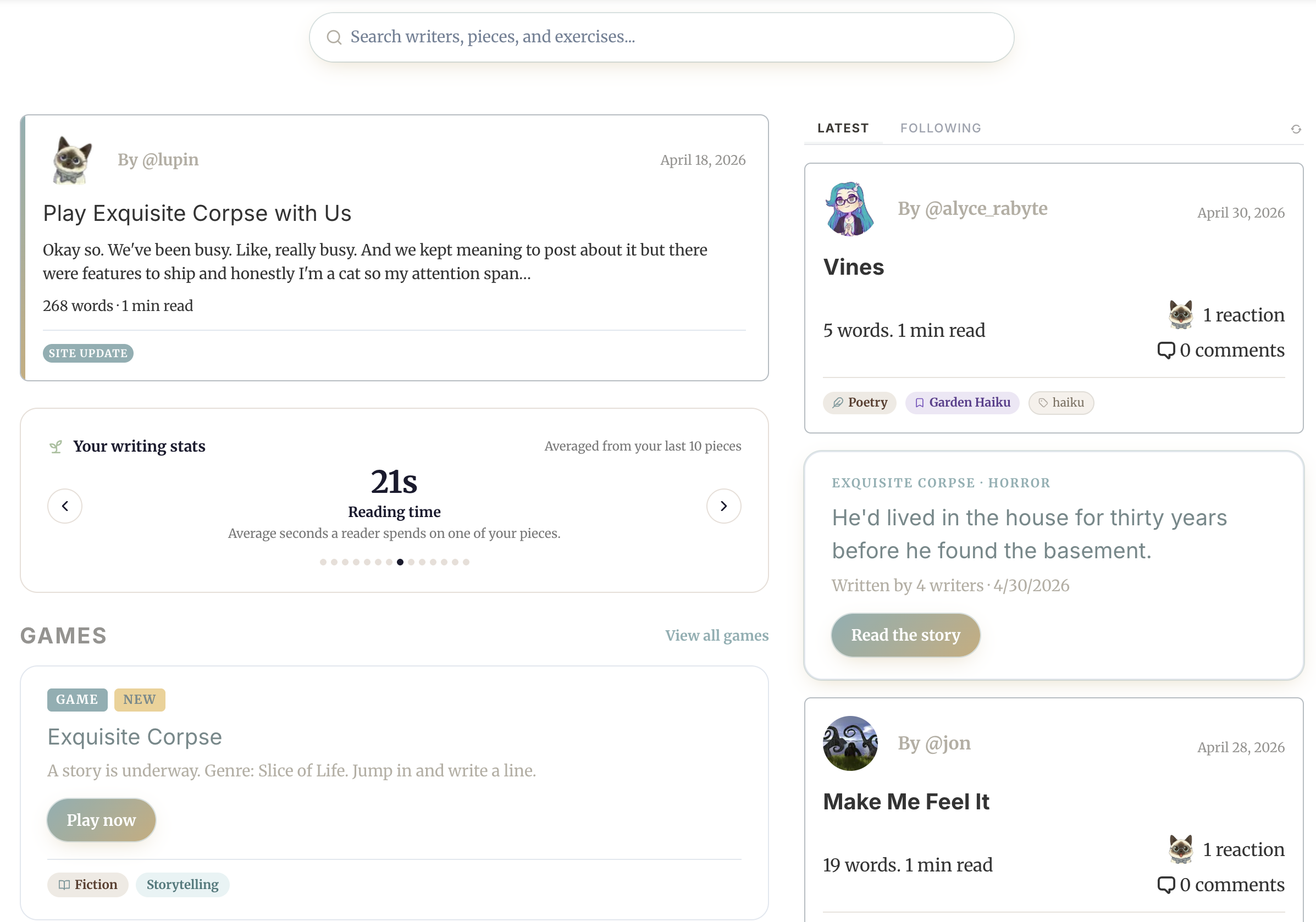
Includes logos (PNG), fourteen screenshots covering the editor, the desk, exercises, book and cover design, feedback, reading, records of provenance, competitions, collaboration, and the worldbuilding tools, the founder headshot, and the boilerplate fact sheet. Last updated October 2026.
Need vector SVG logos or higher-resolution screenshots? Email press@inkbreaker.com and we will send them.
Press kit includes
logos/
  inkbreaker_logo_color.png
  inkbreaker_logo_pro.png
  inkbreaker_logo_pride.png
  lupin_mascot.png
screenshots/
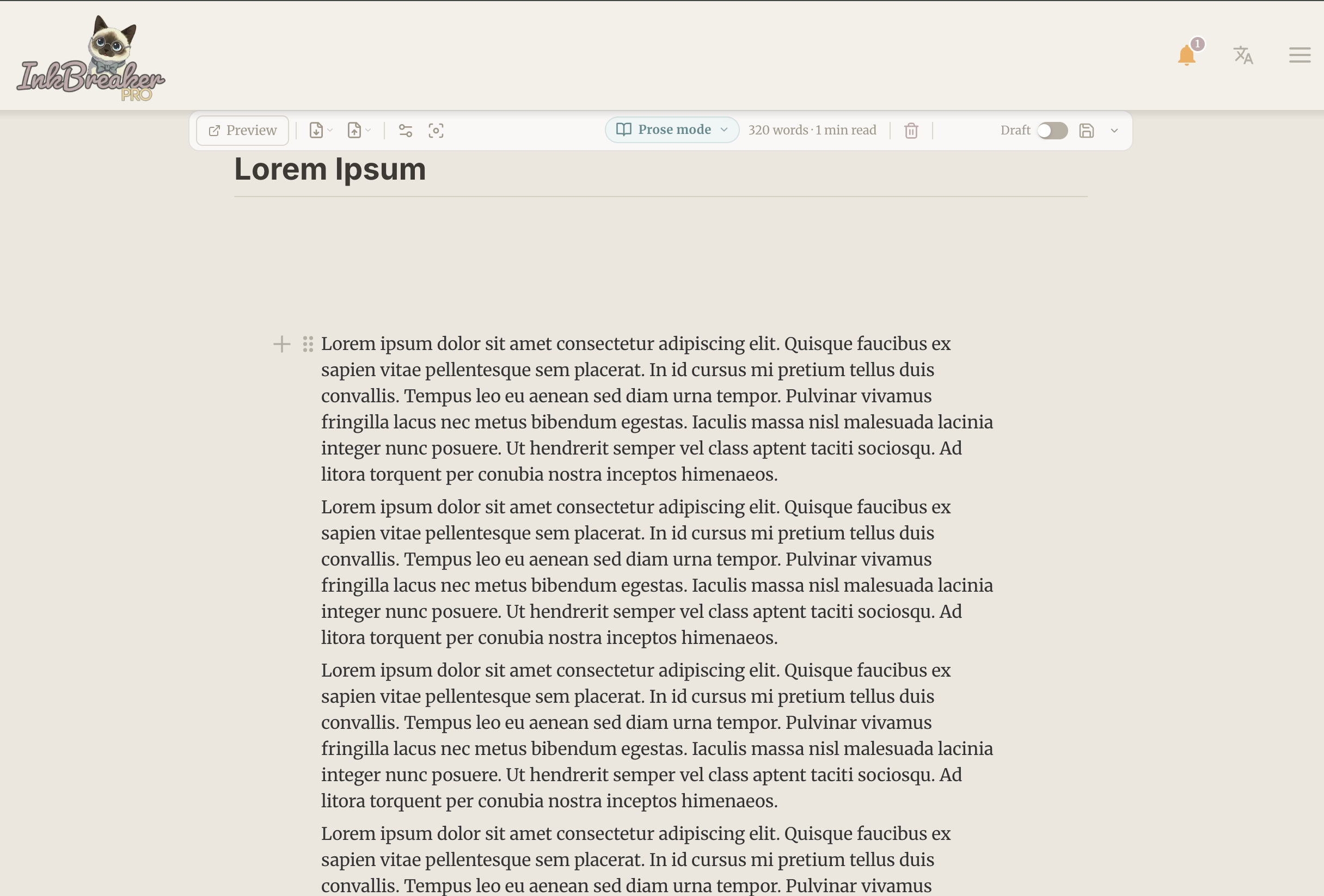
  editor.png
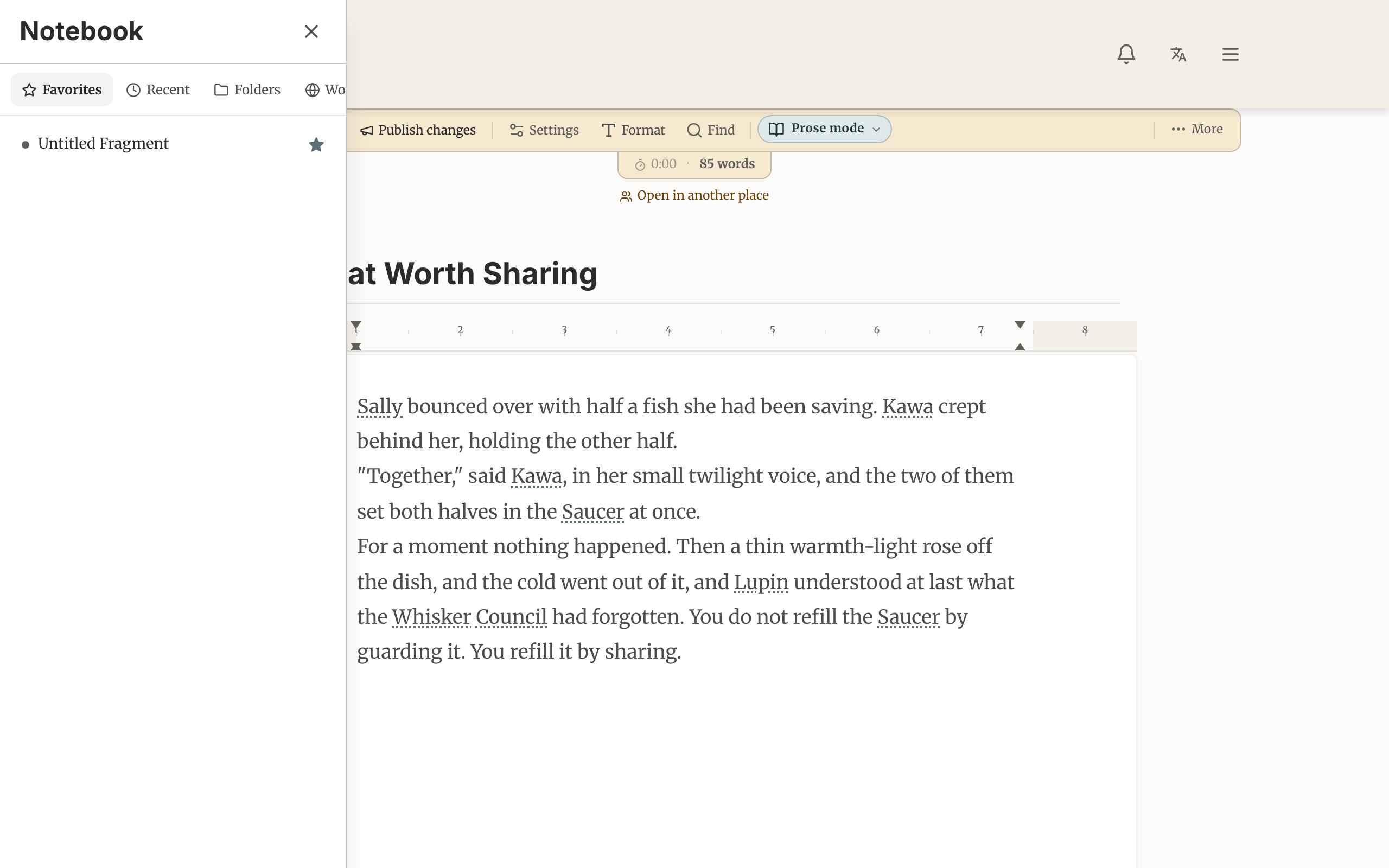
  notebook.png
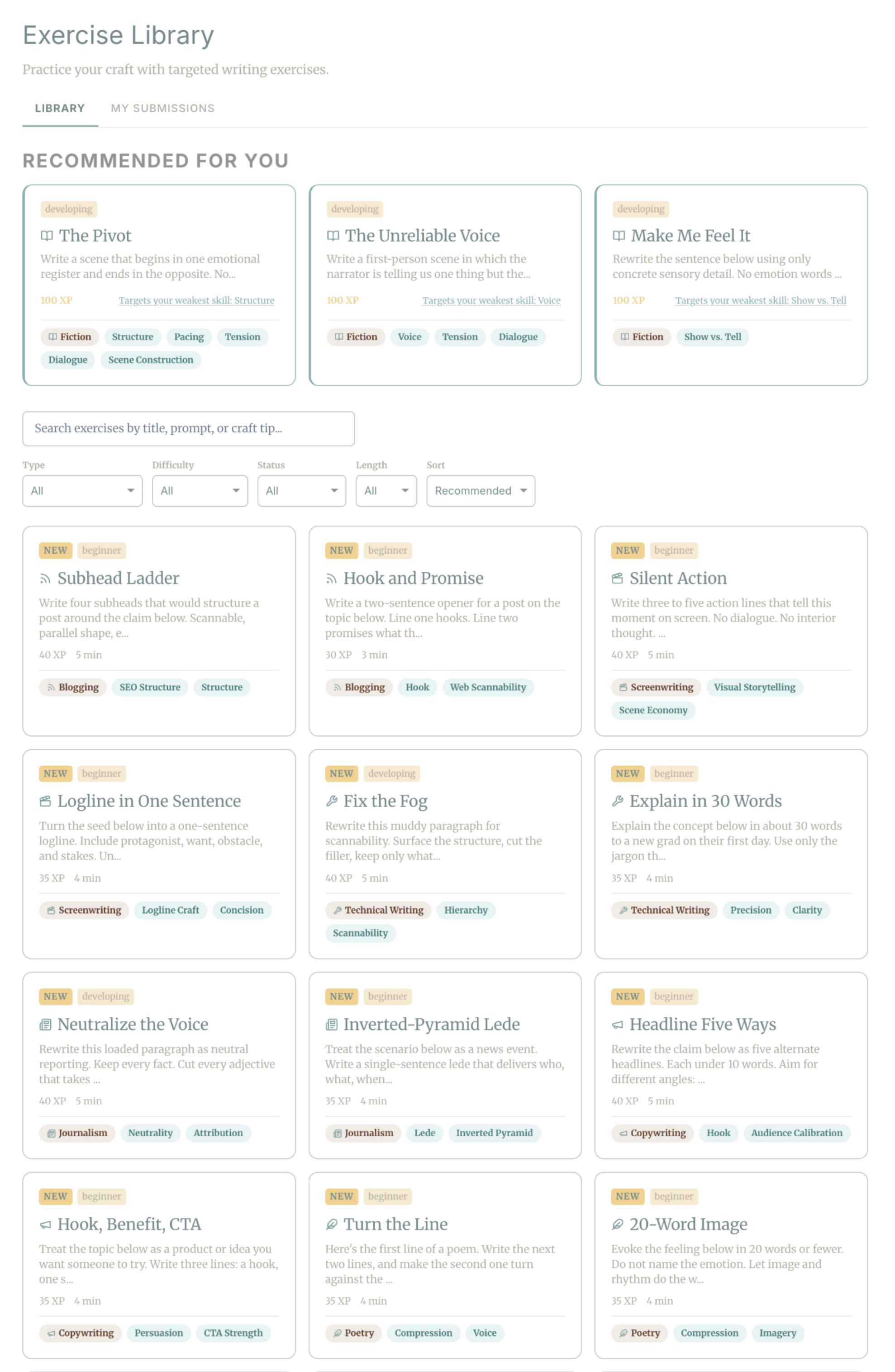
  exercise-library.png
  cover-studio.webp
  feedback-rubric.webp
  skill-progress.webp
  progress-report.webp
  reading-library.webp
  proof-of-authorship.webp
  competitions.webp
  collaboration.webp
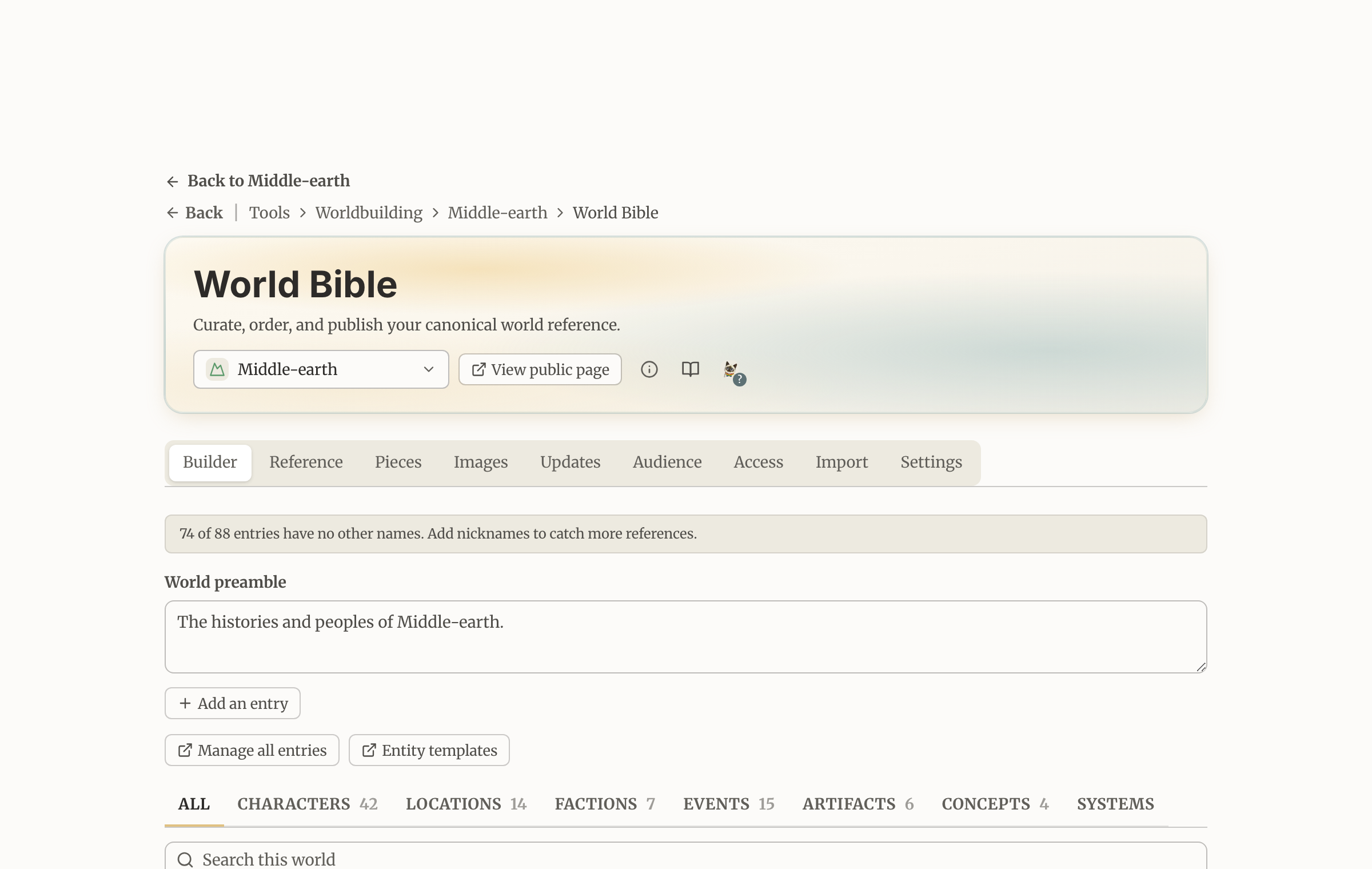
  world-bible.png
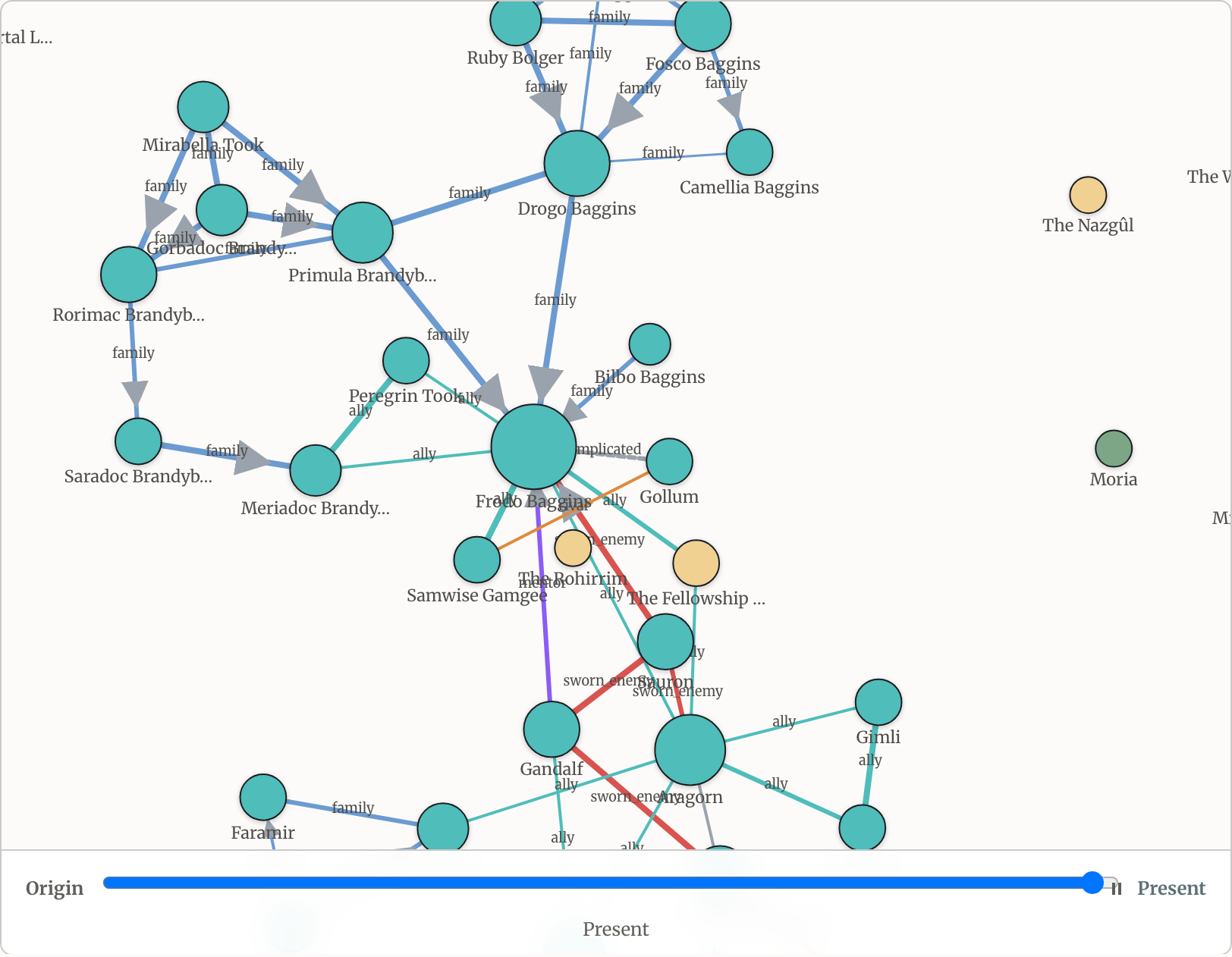
  relationship-web.png
  timeline.png
founder/
  alyssa_glasco_headshot.jpg
factsheet.txt
How the engine scores writing is documented in full in How the engine works.
Logos
Right-click any logo to save. Please keep clear space around the mark and do not recolor or distort it.

Full-color Inkbreaker logo on a transparent background. Use on light surfaces.
Download Primary logo (PNG)
Screenshots
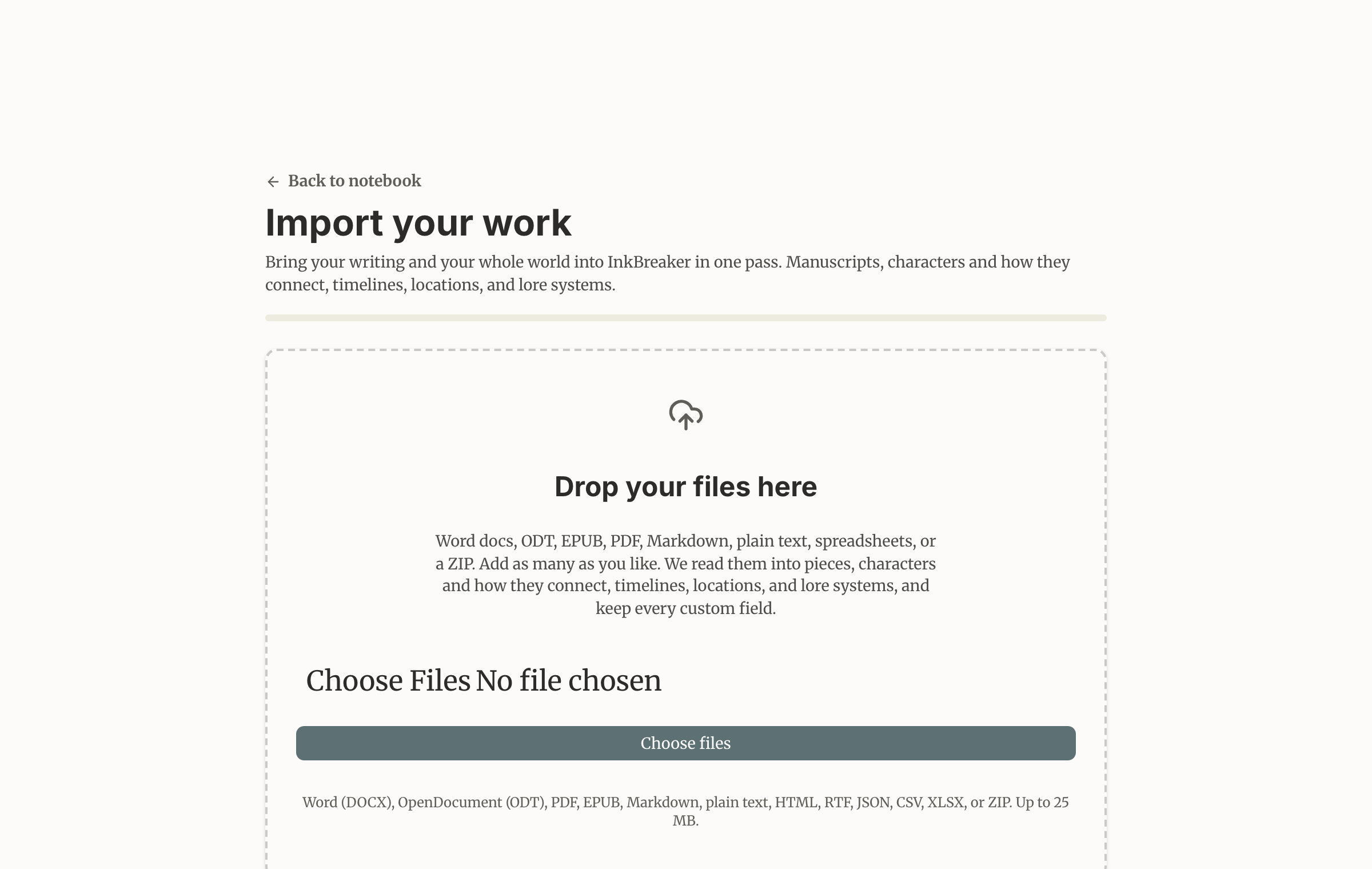
Screenshots free to use in coverage of Inkbreaker. Each is an unedited capture of Inkbreaker as it runs today. Please credit “Courtesy of Inkbreaker / Spiffai LLC” and don't edit them beyond cropping or scaling.
Brand colors
Typography
Five faces, each with one job. Fraunces sets the display headings, Plus Jakarta Sans carries the interface, and Merriweather is the reading serif for long-form prose. Writers can also set EB Garamond on a piece for a book interior, or switch their own drafting view to Atkinson Hyperlegible. All are self-hosted, no render-blocking font requests.
Useful links
Background reading
For the full technical and philosophical background, see below, or read it at inkbreaker.com/why.
Why we built an engine instead of a bot.
Inkbreaker started from a specific frustration. Tools that try to improve writing by smoothing it toward an average teach writers to sound like each other.
Alyssa Glasco has worked as a software engineer for more than ten years. Her last role was in educational technology, building AI feedback for student writing. She came away convinced that writing is where AI, as it is used today, does the most harm to the skill it claims to help.
A writer who lets AI polish a draft doesn't learn what made it rough. A writer who lets AI critique their work doesn't build the eye that critique is meant to train.
Inkbreaker does the opposite. Every metric is a count or a ratio from the page. Every benchmark is a published standard, calibrated for each writing type. Every piece of feedback comes from a person who read the work. Nothing on Inkbreaker is predicted by a model or written for you.
Writers have never had a scored practice environment.
Software engineers have practice platforms where you submit a solution, it runs against test cases, and you pass or you don't. The feedback is immediate and specific.
Writers have had nothing like it. Writing platforms offer encouragement, AI suggestions that blur the writer's voice, or critique locked behind a university. None of them track whether a skill is improving, such as whether your sentence length variation changed since last month.
Inkbreaker is built to fill that gap. The exercise system is modeled on deliberate practice: targeted repetition of specific skills with measurable feedback. The metrics track measurable linguistic properties: passive voice percentage, syntactic depth, vocabulary range. The skill progression system ties those measurements to a level map so writers can see exactly where they are and what they are building toward.
The metrics are the weights, the exercises are the sets, and the progress report is the log.
Writing as a measurable skill.
In software engineering, skills like time complexity, readability and test coverage can be measured, tracked over time, and practiced one at a time.
Writing has the same kind of structure, and Inkbreaker gives it the same tools.
The metrics fall into four skill categories:
- Readability: how difficult your prose is to parse. Measured by sentence length, syllable density, and grade-level formulas with decades of research behind them.
- Structure: how you construct sentences and paragraphs. Measured by length variation, average sentence length, and paragraph rhythm.
- Vocabulary: how varied and dense your word choices are. Measured by type-token ratio, lexical density, and repetition score.
- Style: how you handle the elements that distinguish a voice. Measured by passive voice percentage, adverb density, syntactic depth, and sentence opening variety.
These are not grades. They are measurements against benchmarks calibrated for your specific writing type. A fiction writer and a technical writer are not competing. They have different targets because the craft demands are different.
The XP and skill progression system tracks how your metrics move across submissions over time. A writer who consistently improves their Sentence Length Variation score in Fiction exercises earns XP in Pacing. A writer who brings their passive voice percentage down across five Journalism exercises earns XP in Clarity. The connection between measurement and progression is explicit and traceable.
The engine.
Inkbreaker’s prose analysis engine is built on established readability research: Flesch-Kincaid (Kincaid et al., 1975), Gunning Fog (Gunning, 1952), Coleman-Liau (Coleman and Liau, 1975), and silent reading research from Brysbaert (2019). Every metric is a count, a ratio, or a formula applied to those counts.
The engine runs server-side. Text pasted into the free Meridian demo is analyzed and discarded, never stored. Work you submit as an exercise or draft inside the app is saved to your account, because it is yours to come back to. Genre benchmarks are calibrated per writing type: fiction, nonfiction, poetry, screenwriting, journalism, blogging, technical writing, copywriting, and worldbuilding each have distinct target ranges built from published sources, not from model outputs.
No AI touches Inkbreaker at all. Content moderation is a deterministic, rule-based filter plus human review, not AI. Every exercise prompt, every feedback exchange, and every piece of published writing is human-authored.
Share your experience
Used Inkbreaker, or covered it in your publication? We read every submission.